How CBD Is Made: From Seed to Bottle
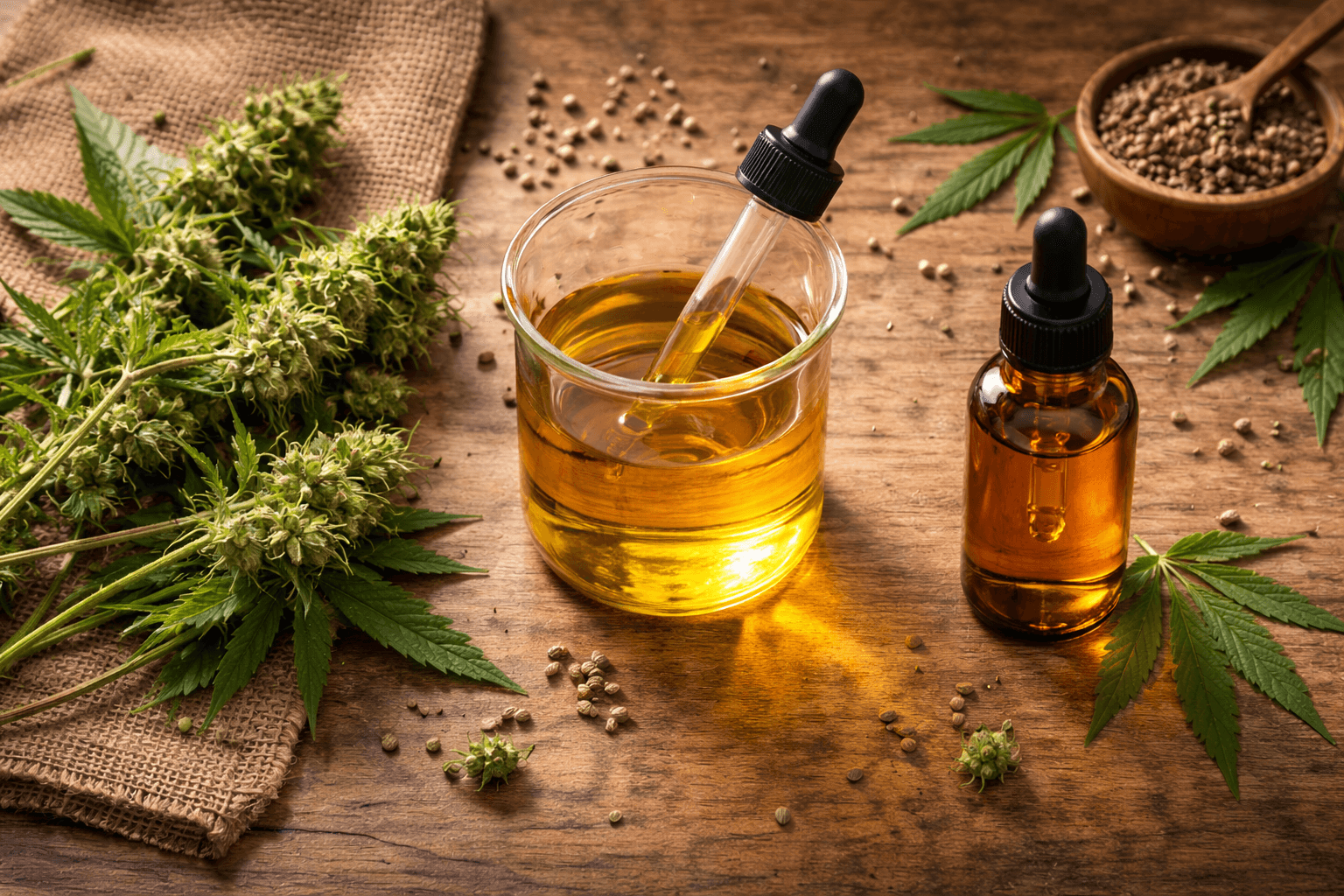
Have you ever wondered how that bottle of CBD oil on your shelf was made? The journey from a hemp seed in the ground to a finished, lab-tested product involves multiple steps, each requiring precision and quality control. Here is the complete process.
Step 1: Hemp Farming and Cultivation
It all starts with the seed. CBD products are derived from industrial hemp, which is legally defined as cannabis containing 0.3% THC or less by dry weight. Quality CBD begins with quality farming.
Key factors in hemp cultivation:
- Genetics: Farmers select cultivars bred for high CBD content and low THC. Popular strains include Cherry Wine, Elektra, and Lifter.
- Soil quality: Hemp is a bioaccumulator, meaning it absorbs whatever is in the soil, including heavy metals, pesticides, and toxins. Organic, clean soil is critical.
- Climate: Hemp thrives in temperate climates with well-drained soil and plenty of sunlight. Most U.S. hemp is grown in Colorado, Oregon, Kentucky, and North Carolina.
- Growing period: Hemp typically takes 3 to 4 months from planting to harvest.
At CJ's Medicine Cabinet, we source hemp from USA-grown organic farms with full traceability from seed to shelf.
Step 2: Harvesting and Drying
Hemp is typically harvested when CBD levels peak and THC remains below the legal limit. The plants are cut, hung upside down, and dried in temperature-controlled environments (60 to 70 degrees Fahrenheit, 45 to 55% humidity) for 5 to 10 days.
Proper drying prevents mold and preserves the cannabinoid and terpene profile. After drying, the plant material is trimmed and prepared for extraction.
Step 3: Extraction Methods
Extraction is the process of pulling CBD and other beneficial compounds out of the raw plant material. There are several methods, each with pros and cons:
CO2 Extraction (Industry Gold Standard)
Supercritical CO2 extraction uses pressurized carbon dioxide to act as a solvent. At specific temperatures and pressures, CO2 becomes "supercritical," meaning it has properties of both a liquid and a gas, allowing it to dissolve cannabinoids and terpenes from the plant.
Advantages: No residual solvents, highly tunable (can target specific compounds), produces clean and potent extracts, environmentally friendly.
Disadvantages: Expensive equipment (machines cost $100,000 to $500,000+), requires trained operators.
Ethanol Extraction
Food-grade ethanol is used to dissolve cannabinoids from the plant material. The ethanol is then evaporated, leaving behind the crude extract.
Advantages: Efficient for large batches, relatively affordable, can produce full spectrum extracts.
Disadvantages: May extract chlorophyll (giving a bitter taste), requires careful purging to remove all solvent residue.
Hydrocarbon Extraction (Butane/Propane)
Common in the cannabis industry but less common for CBD. Uses butane or propane as a solvent.
Advantages: Excellent at preserving terpene profiles.
Disadvantages: Residual solvent risk, flammability hazards, requires extensive post-processing purification.
Oil Infusion (Traditional Method)
The oldest extraction method. Plant material is heated in a carrier oil (like olive oil or coconut oil) to decarboxylate the cannabinoids and transfer them into the oil.
Advantages: Simple, safe, no special equipment needed.
Disadvantages: Low cannabinoid concentration, short shelf life, not commercially scalable.
Step 4: Winterization and Filtration
After initial extraction, the crude extract contains not just cannabinoids and terpenes but also waxes, lipids, and chlorophyll. Winterization removes these unwanted compounds.
The extract is mixed with ethanol and frozen for 24 to 48 hours. At sub-zero temperatures, the waxes and fats solidify and can be filtered out. The remaining solution is then gently heated to evaporate the ethanol, leaving a cleaner extract.
Step 5: Distillation
For products requiring higher purity, the winterized extract undergoes distillation. Short-path distillation uses heat and vacuum pressure to separate individual cannabinoids based on their boiling points.
This process produces a golden, honey-like distillate that is typically 80 to 90% pure CBD. The distillation process can be repeated for even higher purity.
Step 6: Isolate Processing (Optional)
To create CBD isolate (99%+ pure CBD), the distillate goes through an additional chromatography step that removes all remaining cannabinoids, terpenes, and plant compounds. The result is a white crystalline powder of pure CBD.
Step 7: Third-Party Lab Testing
Before any product is formulated, the extract is sent to an independent, ISO-certified laboratory for comprehensive testing:
- Potency: Verifies CBD, THC, and other cannabinoid concentrations match label claims
- Pesticides: Screens for over 60 common pesticides
- Heavy metals: Tests for lead, arsenic, mercury, and cadmium
- Residual solvents: Ensures no extraction solvents remain
- Microbial contaminants: Checks for bacteria, mold, yeast, and E. coli
- Mycotoxins: Tests for toxic compounds produced by mold
At CJ's Medicine Cabinet, every batch is third-party tested and Certificates of Analysis (COAs) are available for all products.
Step 8: Product Formulation
The tested extract is then formulated into finished products:
- Tinctures/Oils: CBD extract is blended with a carrier oil (MCT coconut oil, hemp seed oil, or olive oil) at precise ratios to achieve the desired potency per milliliter.
- Gummies: CBD is mixed into a gummy base (gelatin or pectin), along with natural flavors, sweeteners, and sometimes additional ingredients like melatonin or CBN for sleep formulas.
- Topicals: CBD is incorporated into balms, creams, or salves along with complementary ingredients like menthol, camphor, arnica, or essential oils.
- Softgels: CBD oil is encapsulated in a soft gelatin shell for precise, taste-free dosing.
Step 9: Final Testing and Bottling
After formulation, finished products undergo another round of testing to verify that the final potency matches the label. Products are then bottled, labeled, and packaged in facilities following Good Manufacturing Practices (GMP).
What to Look For in a Quality CBD Product
Understanding how CBD is made helps you identify quality products:
- Source transparency: The company should disclose where their hemp is grown
- Extraction method: CO2 or ethanol extraction are industry standards
- Third-party lab tests: COAs should be publicly available and recent
- No artificial additives: Avoid products with artificial colors, flavors, or preservatives
- Proper labeling: Total CBD per container AND per serving should be clearly stated
- Batch numbers: Every product should have a batch/lot number that corresponds to a COA
Our Process
Every product we carry at CJ's Medicine Cabinet follows these standards: USA grown hemp, CO2 or ethanol extraction, third party lab tested, with COAs available. Browse the shop to see the full lineup, or jump straight to our tinctures if you want to try the most popular format.
This article is for educational purposes only and is not medical advice.