What Is Delta-8 THC?
Delta-8 is believed to have a number of potential health benefits, including pain relief, anti-inflammatory effects, and the ability to stimulate appetite.
How Is Delta-8 Made?
Delta-8 is not normally found very abundantly in hemp, so it has to be made from CBD.
The most common method involves a chemical process of converting CBD into delta-8 THC through isomerization. Isomerization is a chemical reaction that changes the arrangement of atoms in a molecule, resulting in the formation of a new compound.
Here is a general outline of the process:
- CBD is extracted from the hemp plant using a solvent, such as ethanol or CO2. The extraction process yields a crude CBD extract containing a mixture of CBD, other cannabinoids, and plant material.
- The crude CBD extract is then purified into CBD isolate using chromatography, which separates the CBD from other compounds.
- The CBD isolate is mixed with a solvent and heated to a specific temperature to break down the CBD molecule into its individual atoms, which can then be rearranged to form delta-8 THC.
- The mixture is cooled and the solvent is removed, leaving behind a crude delta-8 THC extract.
- The crude extract is purified using chromatography to remove impurities or contaminants.
How Does Delta-8 Differ from Delta-9 THC?
Delta-8 THC is a less common form of THC that is also found in cannabis. It is less psychoactive than delta-9 THC and is thought to have a lower potential for abuse. Delta-8 THC is also thought to have a lower potential for causing anxiety or paranoia, which can sometimes be associated with delta-9 THC.
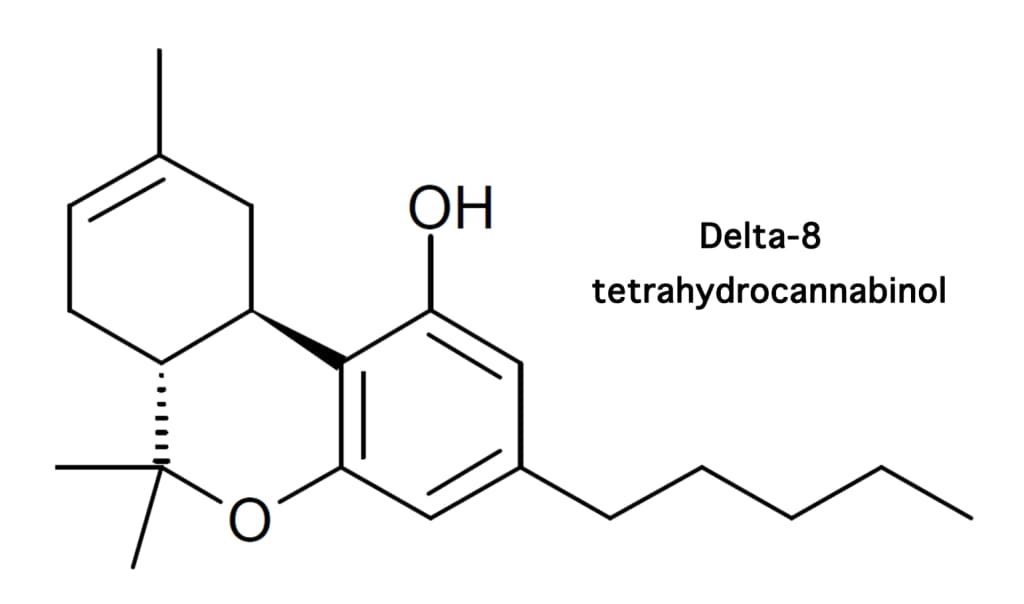
Both compounds have the same chemical formula (C21H30O2) but differ molecularly. Delta-8 THC has a double bond on the 8th carbon atom in its molecular chain, while delta-9 THC has a double bond on the 9th carbon atom.
Looking for Lab Tested Hemp Products
CJ's Medicine Cabinet carries lab tested, hemp derived products compliant with the 2018 Farm Bill. For a milder experience, start with our full spectrum CBD tinctures, which include trace amounts of delta-9 THC (under 0.3%) for the entourage effect. If you want to skip THC entirely, check out our broad spectrum options. Browse the full shop to see what we carry.